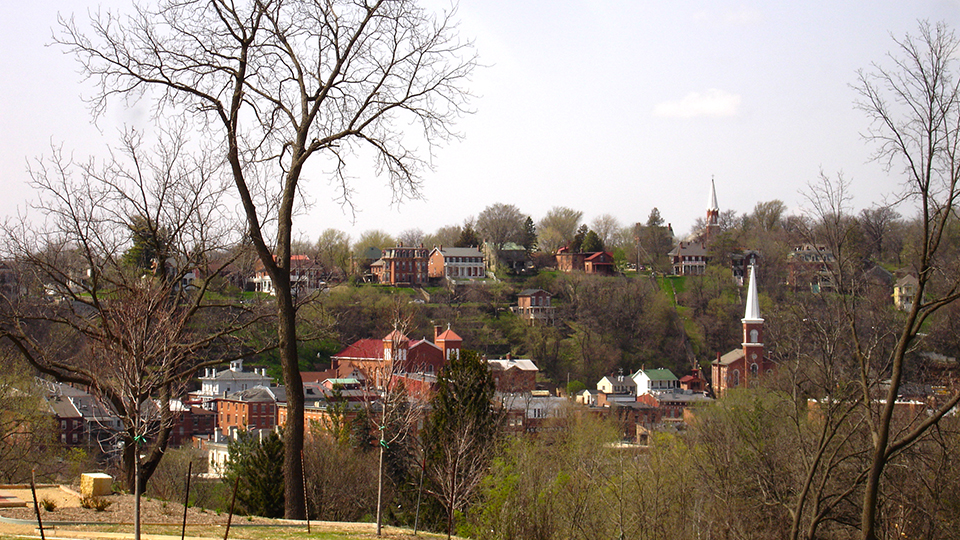
Downtown view of the historic district, IvoShandor, photographer, via wikipedia [cc-3.0]
Physical Description
The Galena Historic District [†] encompasses over 90% of the entire city of Galena, covering approximately 950 acres and containing roughly 1,000 buildings constructed before 1900. The district includes commercial, public, industrial, and residential properties—essentially the older section of a living city.
Architectural Character
Building styles range from simple country architecture of the 1820s-1830s through Greek Revival to Victorian styles. Along Main Street, approximately 150 buildings exist, with only 10 constructed after 1900. Most structures date from the 1840s-1850s with minimal 20th-century modernization. Common building materials include buff-colored native limestone, red-orange locally made brick, wood, and locally cast iron.
Urban Layout
The city features three terraced levels rising from the Galena River:
1. Main Street (lowest terrace)—Principal commercial artery with 3-4 story buildings from the 1840s, curving along the river.
2. Bench Street (middle terrace)—Public and fraternal buildings, principal churches with prominent steeples.
3. Prospect Street (highest terrace)—Primarily residential with wooded backdrop.
Since 1965, new construction and exterior alterations have been regulated by a historic preservation ordinance.
Historical Significance
Early History
Named after the Latin word for lead sulphide (galena), the area was discovered by French explorers in the late 17th century, with lead mines reported as early as 1693. The first post office was established in 1826 to serve the rapidly growing settlement.
Period of Prosperity (1820s-1860s)
Lead mining drove massive growth and wealth accumulation. By the 1840s, Galena became the wealthiest city in Illinois. The Galena River was crucial—over 240 feet wide and deeper than the Mississippi in 1840. Between 1823-1849, 365 different steamboats registered at the U.S. Customs House, making 7,650 trips on the upper Mississippi.
Civil War Era
Thanks to Congressman Elihu B. Washburne, Galena furnished nine generals to the Union Army, including Ulysses S. Grant. Grant arrived in Galena in April 1860 and clerked in his father's Main Street leather and harness store. Upon his return in August 1865 as commander of all Union armies, citizens presented him with a stately brick home. Grant was elected President in 1868 and returned to Galena in 1879, remaining until 1881.
Decline
Glory began fading in the 1860s when railroads diverted commerce from the river. Falling prices devastated the lead and zinc industry. Population declined from 15,000 to 5,000 by the 20th century. The Galena River silted into a sluggish stream.
Cultural Notes
Early prospectors who migrated seasonally rather than staying through harsh Illinois winters were called "suckers" after migratory river fish—the origin of Illinois being called the "Sucker State". The district maintains exceptional architectural consistency and romantic historical traditions. It is recognized for its importance in the pioneer history of the upper Midwest.
Preservation Status
At the time of nomination, the district was in good to excellent condition with preservation work in progress. Multiple surveys had been conducted, including the Historic American Buildings Survey (1934-ongoing) and local architectural inventories (1965-1967). The property was designated as having national significance for its contributions to agriculture, architecture, commerce, industry, military history, politics, and transportation.
†Adapted from: Bruce M. Kriviskey, City Planning Coordinator for the City of Galena, Galena Historic District, nomination document, 1969, National Register of Historic Places, Washington, D.C.
Street Names
4th Street • 5th Street • Adams Street • Field Street • Fulton Street • Hickory Street North • Hill Street • Ridge Street • Spring Street